THE HIMALAYAN TALK: PALASH BISWAS TALKS AGAINST CASTEIST HEGEMONY IN SOUTH ASIA

THE HIMALAYAN TALK: PALASH BISWAS TALKS AGAINST CASTEIST HEGEMONY IN SOUTH ASIA INDIA AGAINST ITS OWN INDIGENOUS PEOPLES

PalahBiswas On Unique Identity No1.mpg

Sunday, May 31, 2015

What a short-sightedness!!Nepal gloriously acknowledge Madhes is its inherent part, so present president, vice president and chief justice hails from Madhes.

What a short-sightedness!!
Nepal gloriously acknowledge Madhes is its inherent part, so present president, vice president and chief justice hails from Madhes.
Dhruba Nepal <dnepal@gmail.com>

It seems that ck raut, kailash mahato and others have lost conscience that Nepal gloriously acknowledge Madhes is its inherent part, so present president, vice president and chief justice hails from Madhes. No pahadi has grudge on it. But, a small case of a pahadi police commits misdeed, that becomes the reason to raise the voice to secede from pahad and establish Madhes as an independent nation.

It is pity to know that a PhD from Cambridge and scientist of the US, which welcome people across the globe to reside in own territory, has such a conservative thinking that people of pahad, who are in trouble, should not get respite and refuge in madhes.  If you are so conservative, we are not so. We welcome you to reside anywhere in pahad either in normal condition or in trouble.

Best regards, 
Dhruba

Protest in Delhi demanding justice for the victims of Atali violence

Protest in Delhi demanding justice for the victims of Atali violence

Submitted by TwoCircles.net on 30 May 2015 - 10:32pm
By TwoCircles.net Staff Reporter,
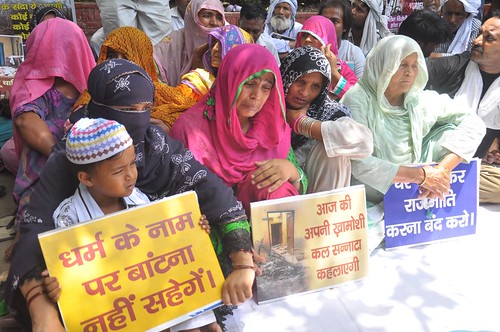
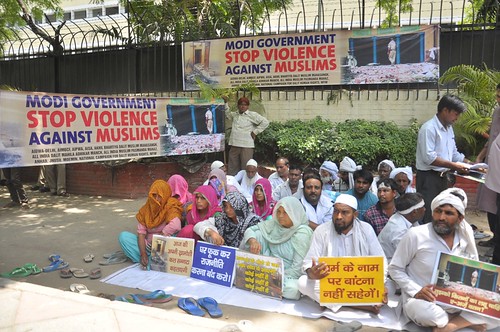
New Delhi: Rights activists, advocates and concerned citizens from different civil society organizations on Saturday staged a protest outside Haryana Bhawan demanding justice for the victims of violence in Atali village, Haryana.
On May 25, the dominant Jat caste unleashed violence and physical attacks on Muslim men and women, burning and looting of homes and shops amidst total apathy of the administration towards the victims of the Muslim community. At least 20 Muslims were injured while their homes, properties, businesses attacked, looted and burnt down.
Protest in Delhi demanding justice for the victims of Atali violence
About 500 Muslims from the village are now camping at the Ballabgarh Police station, afraid to go back. Meanwhile, curfew which was placed in the locality continues.
Some of the victims from Ballabgarh had also come for the protest. Protesters demanded immediate arrest of all the accused, setting up of relief camps for victims, adequate compensation after proper assessment.
Civil society groups have also urged towards creating communal harmony involving civil society groups and NGOs and to ensure and provide security so that Muslims can build the mosque for which they have won the legal battle.
Protest in Delhi demanding justice for the victims of Atali violence
They have also demanded judicial probe into the whole incident to ensure this kind of communal violence does not spread to other parts of Haryana and providing adequate security in the village so that they feel safe and can return back.
The protesters later submitted a memorandum to the Resident Commissioner of Haryana.
Full Text of the Memorandum:
The Resident Commissioner
Govt of Haryana
Haryana Bhawan
Copernicus Marg
New Delhi
Memorandum
Demand Justice to the Muslim Victims of violence by the dominant Jat caste in Atali, Ballabhgarh, Haryana
We, the undersigned comprising of human rights, women activists, advocates and concerned citizens of India from different Civil Society organizations and all those in support of the cause of marginalized people, strongly condemns the communal violence against the Muslim community of Atali, Ballabhgarh by the dominant caste Jats in on 25th of May 2015.
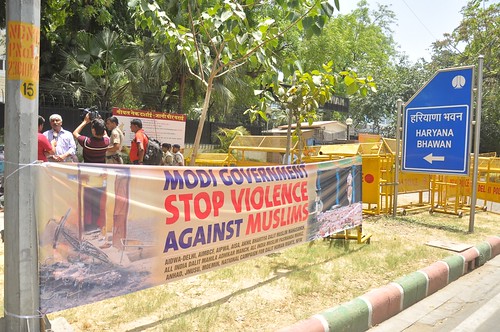
Protest in Delhi demanding justice for the victims of Atali violence
We draw your attention…to the extreme violence, physical attacks on Muslim men and women, burning and looting of homes and shops and total apathy of the administration towards the victims of the Muslim community. We stand here because Muslim women and men have been assaulted, their homes, properties, businesses attacked, looted and burnt down and denied justice. We stand here because the police has so far not arrested any of the accused.
Atali village in Ballabhgarh Tehsil of Faridabad district has become the latest theatre of Anti Muslim carnage in the series of such incidents which have rippled across the country in the last year which was marked by the announcement of 'achche din' for all Indians.
The story line is the same. Muslims begin building a mosque, in this case Atali Jama Masjid. A stay order is obtained from the local court. The case drags for 5 years. Meanwhile nearby a Hindu temple has been built. When the stay is vacated, Muslims build scaffolding and begin work. Just as they are about to lay the roof, a well planned attack on the Muslim community takes place which is executed with precision and with connivance of the local police. Hindu groups claim that the dispute still persists and there was no order to vacate. So taking law in their hands they begin the task of 'teaching them a lesson'. The police knows but remains a silent bystander.
Last night ANHAD's visit to the Ballabhgarh City police station and the Atali village has revealed the facts which are often obfuscated both in official and media accounts. Facts and only facts have to become the basis for immediate action by Haryana State.
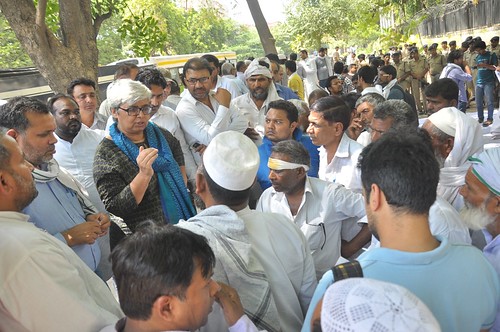
Protest in Delhi demanding justice for the victims of Atali violence
What is being seen as spontaneous action of inflamed Jat youth on Monday morning was not that. It was brewing for a few days, the first stirrings of which were felt as early as Friday when the Muslims assembled for Juma prayers. The police were in the know and deliberately ignored the tension. Their bias is evident in the fact that when the trouble was at its peak, instead of reinforcing the watch, the existing watch was actually with drawn. That places the police also in the circle of suspicion.
Atali is a small village with approximately 150 Muslim houses. It was easy for the marauders to identify the homes of Muslims. It were these houses which were targeted and burnt. The pattern of Gujarat 2002 was replicated on a smaller scale. Apart from our eyewitness account, this fact has been reported as well by media, detailing the burnt Muslim houses and shops on the small strip leading to the mosque site, which were selected and torched.
Such acts of violence and humiliation not only violate basic human rights of the Muslims but also reflect upon the highly communal feudal mindset that continues to prevail in our society. What essentially furthers such atrocities is the impunity that has continued in the cases of communal atrocities. We cannot forget how the perpetrators of violence against hundreds of Muslims in the massacres at Gujarat, Muzzafarnagar and many other places walked away unpunished. The silence of the larger society on the issue of communalism has contributed to the nurturing of this culture of communal atrocities, which has taken such an ugly face for the Muslims. Communalism and its implications for the minorities need to be acknowledged by all and condemned strongly.
Apathy of the state and bias of the police have rendered 400 Muslim women children and men homeless. ANHAD witnessed the sub human conditions in which they are existing in the City PS Ballabhgarh. Approximately 400 homeless people, are lying around in 45 degrees heat with almost no facilities. A few coolers after the NCM intervened and a tent , small food packets from charitable organizations is all that is available to them. 150 women with children are supposed to relieve themselves in two toilets. Their physical trials, quite apart from the mental agony, are phenomenal.
Haryana is the nation's most prosperous state with the highest GSDP. Globally it aspires to become the lead in skill development and Make-in-India. This tragic, contrived and heinous incident which has been beamed across the world will be setback to its image in the eyes of the global business which shies away from places where conflict rages and life is cheap.
It is in everyone's interest that the state gets into action and does what it is supposed to do anyway and which is its primary duty, protect life and property of its people. Having been unable to do that it needs to compensate for its failure.
We therefore demand the following measures to be taken immediately for relief of these afflicted residents of Haryana state.
Immediate arrest of all the accused involved as they may threat the family members of the victims and witnesses. All the accused should be identified and arrested at the earliest. Immediate filing of FIR's against individuals who have been identified by the victims as perpetrators of violence. And follow up action by police to ensure quick trials and conviction. Arrest of the accused involved in attacks and looting and burning of Muslims their households and shops
2. Relief Camps be set up with decent facilities immediately for the 400 odd citizens languishing around the city PS. The word DECENT needs to be carried in letter and spirit, which includes toilet facility, maximum 20 per toilet. 24x7 water, both drinking and utility water. Coolers in each hall/room to withstand present extreme weather condition, regular food supply.
3. Assessment of damaged property with amounts of compensation defined and timeline for payment at the earliest at a rate which is commensurate with the living standard in Haryana state.
4. Trauma counselling for the afflicted persons specially women and children provided in the Camps with immediate effect, given the mental state of the victims
5. Medical teams to be stationed in camps with mandatory referral of patients to secondary and tertiary facilities as needed.
6. State to approach NGOs and civil society to start long term communal harmony programmes in Atali as well as in other villages and districts of Haryana so that this communal virus does not spread any further.
7. Right to worship and building places of worship is a fundamental right. We demand from the Haryana Govt to ensure and provide security so that Muslims can build the Mosque for which they have won the legal battle.
8. We demand creating an atmosphere in the village which is conducive of an early return of the victims with dignity and respect.
9. We demand a judicial probe into the whole incident to ensure this kind of communal violence does not spread to other parts of Haryana.
10. Effective protection to the family members of the injured and other victims whose houses and shops have been looted and burnt.
11. Adequate police security should be deployed to monitor violence and ensure peace in the village.
We request you to consider our demands as most urgent and take appropriate action. This will initiate faith among the ordinary people, especially the weaker sections of our society on the provisions of our protective laws mandated by the Constitution. Further, this will protect them from the oppressive dominant socio-economic system. We are herewith submitting this memorandum for promotion of justice, equity and protection of human rights in society.
Thank you for considering our recommendations and demands. We would appreciate learning about any steps that you take in this regard.
Yours sincerely
Shabnam Hashmi-Anhad, Maimoonah Mollah- AIDWA, Ali Anwar-JDU, Ramzan Choudhry, Asad Ashraf, Annie Raja- NFIW, Apoorvanand, Ovais Sultan, Paul Divakar-NCDHR, Navaid Hamid- MOEMIN, Anant-JNUSU, Yogesh- Naujawan Bharat Sabha, Varuni, Disha, Sanjay Sharma, Pratap Singh Negi, Mohd Aamir, Manan Trivedi-Anhad , Namaldar Ishaque & 100 victims from Atali , Ballabhgarh
On behalf of the following civil society, women, human rights , minority and Dalit organisations:
AIDWA, DELHI, AIMBCF, AIPWA, AISA, AKHIL BHARTIYA DALIT MUSLIM MAHASANGH, ALL INDIA DALIT MAHILA ADHIKAR MANCH, ALL INDIA MUSLIM PASMANDA MAHAZ, ANHAD, JNUSU, MOEMIN, MWF, NATIONAL CAMPAIGN FOR DALIT HUMAN RIGHTS, NFIW, PUCL, UNITED CHRISTIAN FORUM
New Delhi: May 30, 2015

ঢাকায় অপেক্ষাকৃত একটি দুর্বল সরকার প্রতিষ্ঠার মাত্র এক বছরের মাথায় ভারত তার সকল স্বপ্ন পূরণ করতে যাচ্ছে, এটা ইতিপূর্বে কোনও দিন করতে পারেনি। সুতরাং মোদি কি? জয়...! মোদি কি? জয়...!!

ভারত এত ভালো কেন?

শাখাওয়াৎ নয়ন॥

সম্প্রতি বাংলাদেশ-ভারতের সম্পর্ক নাকি ইতিহাসের অন্যতম একটি মহেন্দ্রক্ষণ যাপন করছে(!)। সংবাদ পরিবেশক, বিশ্লেষক, টকশোজীবী, রাজনীতিবিদ, কূটনীতিকসহ প্রায় সব মহলে স্তুতির বন্যা বইছে। তাদের পক্ষে যুক্তি অনেক। এরমধ্যে প্রধান যুক্তিগুলো হলো-  (১) দীর্ঘ প্রতীক্ষিত বাংলাদেশ-ভারত স্থল সীমান্ত সমস্যার সুরাহা (২) বাংলাদেশের সাবেক প্রধান বিরোধীদল বিএনপির পক্ষ থেকে বলা হয়েছে, 'তারা নাকি কোনও দিন ভারতবিরোধী রাজনীতি করেনি এবং করবেও না' (৩) জামায়াতে ইসলামীসহ অন্যান্য ধর্মীয় রাজনৈতিক দল, উপদলের পক্ষ থেকে কোনও ধরনের ভারত-বিদ্বেষ প্রকাশ না করা (৪) মমতা বন্দ্যোপাধ্যায়ের ভূমিকার অকল্পনীয় পরিবর্তন (৫) জনশ্রুতি আছে নরেন্দ্র মোদির ঢাকা সফরে তিস্তা চুক্তির সম্ভাবনা (৬) সীমান্ত হত্যাকাণ্ড বন্ধ হওয়া এবং (৭) বাংলাদেশিদের জন্য ভারতের ভিসা প্রক্রিয়া সহজতর করা।  

এছাড়া আরও অনেক কারণ থাকতে পারে। সেগুলো অবশ্যই আমার আলোচ্য বিষয় নয়। আমার প্রশ্ন এবং চিন্তার বিষয় হচ্ছে- (১) হঠাৎ করে বাংলাদেশের জন্য ভারত এত ভালো হয়ে গেল কেন? (২) দীর্ঘ ৪৪ বছর পর সীমান্তে ছিটমহল সমস্যা সমাধানে ভারতীয় সরকার এবং বিরোধীদলগুলো এত আন্তরিক হয়ে গেল কেন? (৩) ভারত বাংলাদেশকে প্রায় দ্বিগুণের বেশি পরিমাণ ভূমি ছেড়ে দিয়ে লোকসভায় বিল পাস করল কেন? (৪) মমতা বন্দ্যোপাধ্যায়ই বা কেন বিনাযুদ্ধেই মেদেনী (ছিটমহল) ছেড়ে দিলেন? কেনইবা তিনি আজকাল তিস্তা চুক্তির ব্যাপারে ইতিবাচক মনোভাব পোষণ করছেন? (৫) বিএনপি এবং  ধর্মনির্ভর দলগুলো কেনইবা হঠাৎ করে ভারতের প্রতি এত নমনীয় হয়ে গেল? তাদের সারা জীবনের ভারত বিদ্বেষ এখন কোথায় হারিয়ে গেল? কী এমন ঘটনা ঘটল যে, সব কিছুতেই হঠাৎ করে রাতারাতি গণেশ উল্টে গেল?

ঢাকায় অপেক্ষাকৃত একটি দুর্বল সরকার প্রতিষ্ঠার মাত্র এক বছরের মাথায় ভারত তার সকল স্বপ্ন পূরণ করতে যাচ্ছে, এটা ইতিপূর্বে কোনও দিন করতে পারেনি। সুতরাং মোদি কি? জয়...! মোদি কি? জয়...!!       

উল্লিখিত প্রশ্নগুলোর অনেক ধরনের উত্তর থাকতে পারে। কিংবা অনেক ভাবে উত্তর দেওয়া যেতে পারে। আমার তো মনে হয়, ভারত-বাংলাদেশের সম্পর্ক ইতিহাসের একটি ক্রান্তিকালের কাছে এসে উপনীত হয়েছে। কারণ, এই প্রথম আওয়ামী লীগ, বিএনপিসহ বাংলাদেশের সকল রাজনৈতিক দল ভারতকে সব কিছু দিয়ে দেওয়ার জন্য এক পায়ে খাড়া। ব্যাখ্যা বিশ্লেষণে পরে আসছি।

ভারত আসলে হঠাৎ করে বাংলাদেশের জন্য এত ভালো হয়ে যায়নি। একটু খোলাসা করে বলি, ভারত একটি সুদূরপ্রসারী পরিকল্পনা বাস্তবায়নে এগিয়ে যাচ্ছে। যেটা বাংলাদেশের অস্তিত্বের জন্য এক সময় হুমকিস্বরূপ হয়ে যেতে পারে। একথা এখন ওপেন সিক্রেট, শুধু ভারতের সমর্থনের কারণেই আওয়ামী লীগ ৫ই জানুয়ারির নির্বাচনের মতো একটা তামাশা করে এখনও ক্ষমতায় টিকে আছে। তাই টি-স্টল পার্লামেন্টে সবাই একমত- জনগণ নয়, ভারতই এখন ক্ষমতার উৎস। তারাই বাংলাদেশের গদির মালিকানা নির্ধারণ করেন। প্রশ্ন হচ্ছে- ভারত কেনইবা আওয়ামী লীগকে এই ধরনের সমর্থন দিল? কারণটা বুঝতে কারও অসুবিধা হওয়ার কথা নয়; ভারতের ওপর নির্ভরশীল একটি সরকার ছাড়া তাদের সকল চাওয়া পূরণ হবে কিভাবে? তাই তারা প্রথমেই ঢাকায় একটি দুর্বল সরকারকে ক্ষমতায় বসিয়েছে। একইসঙ্গে বিরোধীদলকে ভালোভাবে বুঝিয়ে দিয়েছে যে, আমাদের ছাড়া ক্ষমতায় যাওয়ার আর কোনও উপায় নেই। ফুলে-ফলে বিএনপি এখন 'মোদি' নাম জপতে শুরু করেছে।

ঢাকায় অপেক্ষাকৃত একটি দুর্বল সরকার প্রতিষ্ঠার মাত্র এক বছরের মাথায় ভারত তার সকল স্বপ্ন পূরণ করতে যাচ্ছে, এটা ইতিপূর্বে কোনও দিন করতে পারেনি। সুতরাং মোদি কি? জয়...! মোদি কি? জয়...!!       

এবার আসি স্থলসীমান্ত চুক্তির প্রসঙ্গে। এই চুক্তির জন্য প্রধানমন্ত্রী শেখ হাসিনাকে নিজেদের মাঠে নিজেদের লোকজন ডেকে অপ্রতিনিধীত্বশীল কতিপয় ব্যক্তিবর্গ 'দেশরত্ন' উপাধী দিয়েছেন। উক্ত উপাধি প্রদানকারীদের  মনে এবং শরীরে যথেষ্ট পরিমাণ শঙ্কা থাকায়, প্রদত্ত খেতাব রাষ্ট্রের সকলকে ব্যবহার করতে কিংবা মেনে নিতে বাধ্য করার চিন্তা করছে। খবরে প্রকাশ এই চুক্তির মাধ্যমে বাংলাদেশ নাকি অনেক বেশি পরিমাণে ভূমি কিংবা ছিটমহল পেয়েছে, কিন্তু কার্যত একদিন ঘটনা উল্টে যেতে পারে। পর্দার আড়ালে হয়তো ভারত পুরো বাংলাদেশকেই তাদের একটা ছিটমহল বানানোর কৌশল গ্রহণ করছে। এটা কি সংশ্লিষ্টরা একবারও ভেবে দেখেছেন? সুতরাং এই স্থল সীমান্ত চুক্তির তখন কীইবা মূল্য থাকবে? ইতোমধ্যেই বাংলাদেশের ক্ষমতাসীনদের সঙ্গে যোগসাজশে ট্রানজিটের কথাটি গোপন করে ভারত নানাভাবে ট্রানজিটেরই সকল কর্মকাণ্ড সম্পন্ন করছে- (১) বাংলাদেশের চট্টগ্রাম এবং মংলা পোর্ট ব্যবহারের জন্য অনুমতি দিয়েছে; তার মানে কী দাঁড়ালো? নৌ-ট্রানজিট নিয়েছে অথবা বাংলাদেশ তাদের ইতোমধ্যেই দিয়ে দিয়েছে। বেনাপোল বন্দর দিয়ে ঢাকা-কলকাতা বাস, ট্রেন চলাচল শুরু হয়ে গেছে; শিলং, গৌহাটিতেও বাস যোগাযোগ স্থাপিত হয়েছে; এখন বাকি আছে কী? এখন বাকি আছে ট্রানজিটের ভিন্ন নামে ট্রান্সশিপমেন্ট নামে একটি চুক্তি করা। এই ট্রান্সশিপমেন্টের মাধ্যমে কী ধরনের মালামাল কিংবা পরিবহণ বাংলাদেশের ওপর দিয়ে আগরতলা হয়ে ভারতের সেভেন-সিস্টারখ্যাত অঙ্গরাজ্যগুলোয় যাবে? তা জানতে আর হয়তো বেশি দিন অপেক্ষা করতে হবে না। এক্ষেত্রে আমাদের লোভ দেখানো হচ্ছে- ভারত থেকে বাংলাদেশের ওপর দিয়ে চীন পর্যন্ত এক বিশাল সড়ক যোগাযোগ গড়ে তোলা হবে, তাতে সকলেই অর্থনৈতিকভাবে লাভবান হবে। এই প্রসঙ্গে প্রথম প্রশ্ন হচ্ছে- আমাদের রাস্তা-ঘাট, ব্রিজ-কার্লভার্টের কী অবস্থা? ভারতের অতিকায় সাইজের ট্রাকের ধারণক্ষমতা কি আমাদের রাস্তার কিংবা ব্রিজগুলোর আছে? এখানে সম্ভাব্য উত্তর হচ্ছে- সেই জন্যই তো নরেন্দ্র মোদি এসে একটা বড় সাইজের লোন দেবেন। সেই টাকায় অবকাঠামোগত উন্নয়ন করা হবে। তাহলে ট্রান্সশিপমেন্ট শুধু বাংলাদেশের ওপর দিয়ে হবে কেন? ভারত, পাকিস্তানের ওপর দিয়ে ইরান পর্যন্ত হোক। দেখি তখন ভারত তার নিজের দেশকে পাকিস্তানের জন্য ব্যবহার করতে দেয় কি না? গুজরাট, মুম্বাই কিংবা কলকাতা নৌ-বন্দর পাকিস্তানকে ব্যবহার করতে দিতে রাজি হয় কি না? তখন তারা বলবে, এটা তাদের সার্বভৌমত্বের ইস্যু; তাহলে বাংলাদেশের জন্য কি এসব সার্বভৌমত্বের ইস্যু নয়?  

ট্রানজিটের পক্ষে অনেকে অনেক যুক্তি দিয়ে থাকেন। অনেকে ইউরোপের সীমান্তরক্ষীবিহীন দেশগুলোর উদাহরণ দিয়ে থাকেন। তাদের ভুলে যাওয়া উচিৎ নয়, ইউরোপের দেশগুলোর মধ্যে পারস্পরিক সম্পর্ক আর দক্ষিণ এশিয়ার দেশগুলোর পারস্পরিক সম্পর্ক এক রকম নয়। যেখানে দক্ষিণ এশীয় অঞ্চলে বাংলাদেশ-ভারত-পাকিস্তান-আফগানিস্তান সীমান্তে যুদ্ধ-বিগ্রহ, হত্যা, চোরাচালান, পুশইন, পুশব্যাকের মতো সমস্যা নিয়মিতভাবেই লেগে আছে। সেখানে অবাধ চলাচল কিংবা পণ্য পরিবহণ কারও কারও জন্য সার্বভৌমত্বের ইস্যু হতেই পারে।  

আপনারা যারা ভাবছেন, আমি একজন কট্টর ভারতবিরোধী মানুষ, প্লিজ, আমাকে আত্মপক্ষ সমর্থনের সুযোগ দিন। আমি একজন কট্টর দেশপ্রেমিক; ভারতের বিরোধিতা করছি আমাদের স্বাধীনতা এবং সার্বভৌমত্বের প্রশ্নে। এক্ষেত্রে ছাড় দেব কিভাবে? আমি একজন মুক্তিযোদ্ধার সন্তান; একদিন এমন হবে না তো? আমার সন্তান আবার মুক্তিযুদ্ধ করবে ভারতের বিরুদ্ধে? আমার এই শঙ্কার পেছনে অনেক কারণ আছে, ভারত দক্ষিণ এশিয়ার একমাত্র সাম্রাজ্যবাদী দেশ, এই দেশটির সঙ্গে যেকোনও ধরনের সম্পর্ক বহুভাবে চিন্তা করার অবকাশ থাকে। এ অঞ্চলে একমাত্র ভারতই প্রতিবেশী দেশগুলোর জন্য সার্বভৌমত্বের হুমকি হয়ে আবির্ভুত হয়েছে। কয়েকটি উদাহরণ দেওয়া যাক, সিকিম নামক একটি দেশ ছিল, আজ আর তা নেই। ভারত সিকিমকে গিলে ফেলেছে। ভুটান থেকেও নেই। মালদ্বীপকে ভারত তার একটি করোদ রাষ্ট্রে পরিণত করেছে। তাদের কোনও সেনাবাহিনী রাখতে দেয়নি। শুধু পুলিশ, সেই পুলিশই মালদ্বীপে ভারতের ইন্দনে সামরিক ক্যু সংঘটিত করে। আমরা জানি, নেপালের কোনও সামুদ্রিক বন্দর নেই, তাই তারা ভারতের ওপর অনেকখানি নির্ভরশীল; একবার দিল্লি সরকারের আজ্ঞা পালনে কিছুটা ব্যত্যয় ঘটলে, নেপালের আমদানি-রফতানি বন্ধ করে দিয়েছিল ভারত। তারপরে নেপালের আর কোনও সরকার দিল্লির সঙ্গে কোনওদিন বেয়াদবি করেনি। সম্প্রতি নেপালের ভয়াবহ ভূমিকম্পের কথা কে না জনে? কিন্তু একটি খবর হয়তো সকলের নজরে আসেনি; নেপালের সরকার আনুষ্ঠানিকভাবে ত্রাণ-চিকিৎসা এবং উদ্ধারকার্যে ছুটে আসা বিদেশিদের তার দেশ থেকে চলে যেতে বলেছে। ঘটনাটি কি বিস্ময়কর নয়? সাহায্য করতে আসা মানুষকে কোনও দেশ এইভাবে চলে যেতে বলে? বিষয়টি নজিরবিহীন নয়? না, নজিরবিহীন নয়। একটু মনে করার চেষ্টা করুন; ১৯৯১ সালের ২৯ এপ্রিল চট্টগ্রামে ঘূর্ণিঝড়ে বাংলাদেশের প্রায় এক লাখ লোক মারা গিয়েছিল; ঘর-বাড়ি, ব্যবসা-বাণিজ্য ধ্বংস হয়ে গিয়েছিল। আমেরিকান নৌবাহিনীর একটি উদ্ধারকারী দল হেলিকপ্টার নিয়ে সাহায্যের জন্য ছুটে এসেছিল। বিভিন্ন দেশ সাহায্য দিতে চাইল। কিন্তু দিল্লি সরকারের মাথা খারাপ হওয়ার জোগাড়। এসব তাদের পছন্দ হলো না। ভারতের প্রধানমন্ত্রী তখন চন্দ্র শেখর। তিনি হঠাৎ করে এক ঘণ্টার জন্য ঢাকায় আসলেন। বাংলাদেশের প্রধানমন্ত্রী তখন  খালেদা জিয়া। তিনি আদিষ্ট হয়ে ঢাকা এয়ারপোর্টে গিয়েই চন্দ্র শেখরের সঙ্গে দেখা করলেন। চন্দ্র শেখর সাফ-সাফ বলে দিলেন, 'বাংলাদেশের যত সাহায্য লাগবে, ভারত তা করতে প্রস্তুত আছে। বাংলাদেশের অন্য কোনও দেশ থেকে সাহায্য নেওয়ার প্রয়োজন নেই।' আমার কথা হচ্ছে, বাংলাদেশের সাহায্য প্রয়োজন আছে কি নেই; সেটা তুমি বলার কে, চন্দ্র শেখর? নেপাল থেকে বিদেশিদের চলে যেতে বলার ঘটনাটি বাংলাদেশের ঘটনার সঙ্গে কেমন জানি মিলে যাচ্ছে, তাই না?

গঙ্গায় ফারাক্কা বাঁধ দিয়ে, তিস্তায় বাঁধ দিয়ে, টিপাইমুখে পানি আটকে রেখে বাংলাদেশের বারোটা বাজানোর ঘটনাগুলো এত সহজে অগুরুত্বপূর্ণ হয়ে গেল? আজকাল এত বড় বড় ইস্যু নিয়ে কেউ কিছু বলছে না কেন?  

আমরা কি সবাই ভুলে গেছি? আমাদের কি কারও কিছুই মনে নেই? গড়ে প্রায় প্রতিদিন ভারতীয় বিএসএফরা গুলি করে বাংলাদেশিদের হত্যা করত; অসহায় দরিদ্র তরুণী ফেলানীকে হত্যা করে কাঁটাতারের সঙ্গে ঝুলিয়ে রাখার ঘটনা কারও ডিমেনশিয়া (স্মৃতিবিভ্রাট সংক্রান্ত রোগ) না হলে তো ভুলে যাওয়ার কথা নয়। বিএসএফ কতৃক বাংলাদেশিদের গরু ছাগল নিয়ে যাওয়ার ঘটনা তো কোনও খবরের মর্যাদাই পেত না। বাংলাদেশের অদূরে সীমান্তের ওপারে ভারতীয়রা ফেন্সিডিলের কারখানা বানিয়ে বাংলাদেশের যুবসমাজকে ধ্বংস করার ঘটনা কে না জানত? গঙ্গায় ফারাক্কা বাঁধ দিয়ে, তিস্তায় বাঁধ দিয়ে, টিপাইমুখে পানি আটকে রেখে বাংলাদেশের বারোটা বাজানোর ঘটনাগুলো এত সহজে অগুরুত্বপূর্ণ হয়ে গেল? আজকাল এত বড় বড় ইস্যু নিয়ে কেউ কিছু বলছে না কেন?  

কেন জানি বাংলা সিনেমার ফালতু কাহিনির মতো কোনও একটা দুর্ঘটনায় আমাদের পুরো জাতির স্মৃতিবিভ্রাট হয়ে গেছে। তাই কারও কিছুই মনে পড়ছে না। সবাই মিলে মোদিস্তুতিবাদে ব্যস্ত হয়ে পড়েছে। অথচ এই নরেন্দ্র মোদিই গুজরাট দাঙ্গায় হাজার হাজার মুসলিম হত্যার অভিযোগে প্রধানতম আসামি ছিলেন। ভারতীয় আদালত তার বিরুদ্ধে অভিযোগ প্রমাণ করতে না পারলেও, ভারতের প্রত্যেক মুসলমানই জানে মোদি কী জিনিস(!) ? 

লেখক: কথাসাহিত্যিক, একাডেমিক, ন্যাশনাল ইউনিভার্সিটি অব সিঙ্গাপুর।  

ইমেইলঃ nayonshakhawat@yahoo.com    

http://www.banglatribune.com/news/show/99920

__._,_.___

When IIT Madras took action against the Ambedkar - Periyar Study Circle, because they didn't like Mr Modi, protests erupted from numerous student groups and organisations in Chennai on May 30

Roy Daniels
Picture 1 of 4:
When IIT Madras took action against the Ambedkar - Periyar Study Circle, because they didn't like Mr Modi, protests erupted from numerous student groups and organisations in Chennai on May 30. Picture1 shows a little girl protesting, one of India's 69%, shouting slogans against Mr Modi and Smriti Irani. Although born before Mr Modi became prime minister, and so born in shame, she must be the noblest and most intelligent kid in India. With kids like this the country obviously has a great future. Picture2 shows Jayalalitha's police arresting the protesters. Picture3 shows the little girl, the great threat to Mr Modi's government, crying as she is taken away by the police and is denied the right to protest. And finally, Picture4 shows Mr Modi's most dangerous and deadly enemy in the police arrest van, on the way to the lock up. Phew, Mr Modi escaped the greatest attack on his office just a few days after his first year in power. Truly, like he says, he is a lucky man...


A Look at India’s History of Sedition Cases

A Look at India's History of Sedition Cases


A Law Less Majestic
Sanctioned by an archaic law and other draconian legislation, sedit ion against the state is a handy tool to fell voices of dissent

USHINOR MAJUMDAR

SeditionUAPA

Section 124A, Indian Penal Code, 1860:"Whoever, by words, either spoken or written, or by signs, or by visible representation, or otherwise, brings or attempts to bring into hatred or contempt, or excites or attempts to excite disaffection towards the government established by law in India." Punishment: Fine, or imprisonment of three years to life. Shall be punished with 104 (im­prisonment for life), to which fine may be added, or with impris­onment which may extend to three years, to which fine may be added, or with fine.Exception: Criticism, to be determined by the judiciaryUnlawful Activities Prevention Act, 1967:Following a constitutional amendment, UAPA was enacted to "impose, by law, reasonable restrictions in the interests of the sovereignty and integrity of India, on the (i) freedom of speech and expression (ii) right to assemble peaceably and without arms and (iii) right to form associations or unions"Punishment: Penalties ranging from five years to life imprisonment along with fines. If the offence leads to loss of life, a death sentence can be awarded. Unlawful associations: Secessionist and terrorist associations; to be determined and notified by ministry of home affairs

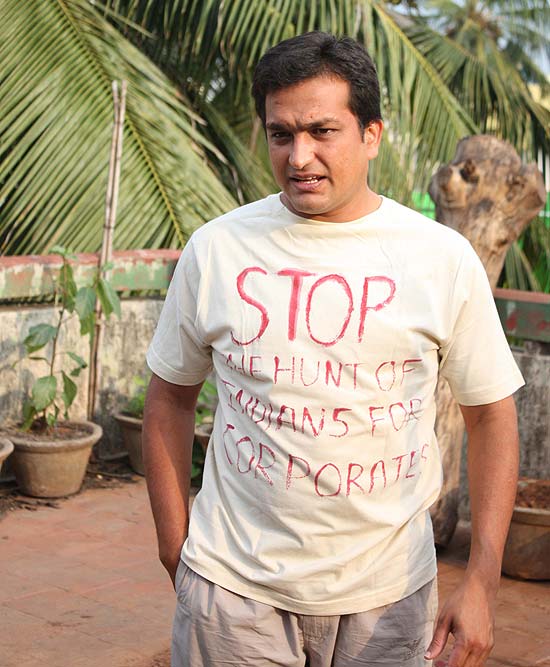
*** Behind every man who has been labelled 'seditious' by the State is a law that goes back 155 years. Section 124A of the Indian Penal Code dates to 1860, three years after the British were rattled by what came to be known as the Sepoy Mutiny. There is also the Unlawful Activities Prevention Act, a handy tool to silence 'dangerous' people with 'dangerous' ideas. Why, a week before it was held unconstitutional, Samajwadi Party leader and UP cabinet minister Azam Khan used Section 66A of the Information Technology Act to penalise a Class 11 student in Rampur, Uttar Pradesh. The police are arbitrary and indiscriminate in the use of the sedition law, arresting people even for activities like singing, acting in street plays, reciting poems, painting graffiti on walls, not standing up during the national anthem or for cheering the Pakistani cricket team. These have, of course, usually accompa­nied the more serious charges of sympathising, funding or acting with Maoists or suspected terror organisations.  Piyush Sethia39 Environmentalist and human rights activist, Salem, Tamil Nadu On Republic Day 2010, Sethia went to then Union home minister P. Chidambaram's home constituency in Tamil Nadu to protest against human rights violations under Operation Green Hunt. "Stop the hunt of Indians for corporates," read the legend on his T-shirt. But before he could start distributing pamphlets in Tamil Nadu for a cycle yatra, the policemen took a look at the pamphlet, consulted their seniors and whisked him away. Around 12 hours later, he was produced before a magistrate and sent to jail on sedition charges, before the Madras High Court ordered him to be released on bail after 23 days.

Status: Five years on, the chargesheet is yet to be filed in a case in which the police had opposed bail and sought an extended remand. Nobody knows the exact number of people who stand char­ged under these laws, but anecdotal evidence puts their number in thousands, many of them faceless tribals hauled up for allegedly sheltering Maoists, feeding them or having been seen in the company of rebels, a reality Jairam Ramesh acknowledged when he was Union minister for rural development. The police get away by saying they had intelligence inputs, secret reports or confessional statements. The judiciary fails to question the police or even grant bail in cases where det­ention serves no purpose other than breaking an individual's spirit or ruining a family. In case after case, the prosecution fails to prove the charges, leading eventually to acquittals.

"The law is misused rampantly. In Koodankulam, the govt filed 1,000 plus sedition cases. Despite SC directions, they haven't been withdrawn yet."Prashant Bhushan, Senior Advocate, New Delhi

In the landmark 1962 judgement in Kedar Nath Singh vs State of Bihar, even though the Supreme Court had held the sedition law as constitutionally valid because the speech in question had incited people to violent action and was not just criticism of the government, but had directed that evidence of either violence or an incitement to violence against the state is necessary for detention. As recently as March 18, the Bombay High Court, while deciding a PIL against cartoo­nist Aseem Trivedi's arrest in 2012, upheld the sedition law, but said guidelines were necessary for arrests.Yet this is routinely disregarded, with  SPs, and deputy SPs and magistrates deciding what amounts to sedition. At a convention of the People's Union for Civil Liberties in 2012, former Delhi High Court chief justice Rajinder Sachar had quipped that even he could have been booked for sedition for talking to suspected Maoists or terrorists! But while the United Kingdom repealed the law in 2010 after having tried the last case of sedition way back in 1972, in India the government is unlikely—and possibly unwilling—to repeal such laws. Have they reduced threats to India? The jury is still out. Meanwhile countless individuals are paying a price for something they have not done.  Photograph by S. Mukherjee Sangram Mohanty34 Businessman and political activist, Brahmapur, OrissaDescribed as a dreaded Maoist who regularly met Maoist leaders and discussed how to overthrow the government and plan bombings etc, police relied on villagers who had overheard conversations about secret meetings while collecting wood. These alleged meetings would then be linked to incidents like the 'IEDs found based on secret information' and implicate Mohanty. Rape and molestation cases were also filed against him .

Status: Mohanty stepped out of jail a day after R-Day this year, having spent three years in jail and granted bail by the Supreme Court, which the high court had denied. This despite villagers denying giving statements to the police implicating him and after the alleged rape victim refused medical examination. But while the Orissa police had filed an affidavit before the apex court declaring there were no more cases against him, Mohanty was arrested outside the jail and booked in two more cases. The SC, in a rare gesture, intervened again and granted him bail a second time. *** In the national award-winning film Court, you could be forgi­ven for thinking that the central character—the ageing activist Narayan Tamble, charged with inciting war and hatred against the nation—is a figment of a very vivid imagination. But Tamble could well be Sudhir Dhawale, the Dalit rights cultural activist arrested at a seminar on atrocities on Dalits; San­gram and Dandapani Mohanty, arrested and rearrested despite Supreme Court bail orders; Piyush Sethia, who wore his opposition on his tee. Or G.N. Saibaba, whose plight Arundhati Roy has evocatively outlined in the preceding pages.

"Recently the Supreme Court said that there should be guidelines for arrests under sedition laws. But the law itself should be deleted."Vrinda Grover, Senior Advocate, New Delhi

The case against Dhawale was built on the alleged confession of another activist (see box). He was expecting it, says Dhawale, he knew his activism was hurting several political parties. He was also campaigning against a village-level dispute resolution scheme called the Mahatma Gandhi Tanta Mukti Abhiyan. It was being run by upper-caste Hindus, he claims, and it was them he antagonised and paid for with three years in jail. And while the court did not find any evidence to hold him guilty, police officers who built up the case against him got away without so much as a showcause!Dhawale does not deny his faith in the Marxist-Leninist-Maoist ideology.

He had worked as a cultural activist with Vidyarthi Pragati Sangathana and Ahwan Natya Manch from 1985 to 1994, organisations the police views as fronts for the erstwhile CPI-ml. When these organisations disappeared from Nagpur, Dhawale took to mainstream activism and continued to work on caste-based atrocities and Dalit rights. The Maharasthra police claimed to have arrested Dhawale with 'Naxal literature' despite the apex court verdict in the Binayak Sen case saying carrying Maoist literature didn't mean the person practised the principles.

The sedition charge ensured he was denied bail. "I was able to secure an acquittal with the help and support of many people," he told Outlook. "But I've seen several inm­ates, especially tribals, in jail on similar charges. They are too poor to fight the state's might." Dhawale's lawyer Surendra Gad­ling—who's now representing Dr Saibaba—cites the example of a tribal woman who was recently granted bail but whose family was so poor they could not come to get her, and she could not afford to go back. *** Inside the warden's residence at Gwyer Hall in Delhi Univer­sity's sprawling and leafy north campus, Vasantha, Dr Saibaba's wife, shuttles between the kitchen brewing tea and showing documents from a growing pile and checking on her daughter in the next room. In the yard outside, a scooter, with extra wheels to ensure balance for the physically disabled, gathers dust. Books on Marx, Lenin, Stalin, Mao, other Left thinkers and academics line the bookshelves in the drawing room.

"I have not seen sedition charges stick in my 22 years of trial court experience. In 99 per cent cases, the police also know it too well."Surendra Gadling, Advocate, Nagpur

The university administration has ordered their eviction. Dr Saibaba's family would have been homeless had it not been for a temporary injunction from the court staying the order.A government communique classified 'secret' suggests Dr Saibaba had been recruiting academicians, doctors and others to become part of Maoist frontal organisations to raise funds and procure weapons for an armed revolution.

The police claim to have found frequent communication between one Prakash and Maoist leaders. Saibaba, they say in the chargesheet, was Prakash. None of the letters is handwritten or signed nor did any neutral witness attest that the police found them at Dr Saibaba's residence during the raid. The only 'genuine' letter the police produced, says Vasan­tha, is one in which her husband and several other intellectuals had appealed to Maoist leader 'Azad' to engage in peace talks with then Union home minister P. Chidambaram. (The negotiations never took place because Azad was shot dead en route to the peace talks).

Today, the family faces an uncertain future. Vasantha inquires how she can raise funds. She is now part of a group called Women in Conflict, because the government has brought the conflict out of the heavy-forested areas of Central India to their home in DU. *** Photograph by Amit Haralkar Sudhir Dhawale46 Activist against atrocities on Dalits, Byculla, Mumbai In 2011, Dhawale was attending a rally against atrocities on Dalits when the police picked him up. Booked under UAPA, police told the court that Dhawale was a 'card-carrying Maoist'. Other arrested activists had made incriminating statements against him, Maoist literature was found on him at the time of arrest, the police claimed. They opposed his pleas for bail, and the courts denied it.

Status: Activists denied before the court that they had ever 'confessed' or identified Dhawale as a Maoist. Prosecution failed to prove that Dhawale was a member of the banned organisation, participated in any terrorist activities and the Maoist literature was found to be available online. Acquitted after three years in jail. Barely five days after he had joined the Odisha Jana Morcha (OJM), the party floated by chief minister Naveen Patnaik's advisor-turned-rival Pyarimohan Mohapatra, plainclothes policemen whisked away Sangram Keshari Mohanty, an engineer-cum-lawyer-turned-businessman on December 5, 2012.

A vehicle without a number plate had sidled up to his motorbike while he was on his way to a garage to get a truck repaired. His family learned of his arrest after local TV channels beamed the police claiming to have nabbed "a Maoist courier and supplier" with "dry fruits, dry fish and Naxal literature" on him. His father, Dandapani Mohanty, an ex-revolutionary, had been the interlocutor between the state government and the Maoists following the abduction of IAS officer Vineel Krishna, bjd legislator Jhina Hikaka and two Italian tourists. "My son has never been part of any radical left movement," he had told this correspondent then, sitting at home, the wall in front showcasing Lenin, Marx, other left-wing thinkers and Bhagat Singh. The senior Mohanty was arrested two months later when he went on a hunger strike for his son's cause. *** In 2008, the Gujarat edition of the Times of India was sued twice for sedition. Sociologist Ashis Nandy was charged first for a column on the post-Godhra turmoil in Gujarat.

Later, a reporter from the newspaper was charged for questioning the appointment of O.P. Mathur as the police chief of the state capital, highlighting his links with the underworld. Another story allegedly sugges­ted how the post was a reward by the Gujarat government for Mathur botching up the probe as investigator into Sohrabuddin Sheikh's fake encounter. It was left to the Gujarat High Court to hold that the articles were not seditious, based on an earlier apex court ruling that an individual public servant (in this case the police chief) could not be confused with the state.

Calling the charge absurd, the judge said, "…then every argument/comment against the manner and functioning of the government might be alleged to lead to the hatred of the government, and it might be suggested that such comments brought the government into hatred or contempt." And you still say we need an 1860 law in 2015? http://www.outlookindia.com/article/a-law-less-majestic/294284

Tripura has shown us how to get rid of one of India’s most abusive laws – #AFSPA

Tripura has shown us how to get rid of one of India's most abusive laws – #AFSPA

The state increased the number of police stations and made the army redundant, ensuring that AFSPA could eventually be withdrawn.
Tripura has shown us how to get rid of one of India's most abusive laws – AFSPA

Photo Credit: AFP/STR
Tripura has in many ways been quietly leading by example: its human development indicators are among the best in the country and it is now the first state in the North East to do away with the Armed Forces (Special Powers) Act or AFPSA.

The Armed Forces (Special Powers Act), 1958, and the Armed Forces (J&K) Special Powers Act, 1990, have been in force in parts of North East India since 1958 and in Jammu and Kashmir since 1990. These laws give sweeping powers to soldiers, including the powers to shoot to kill in certain situations and to arrest people without warrants. They also provide virtual immunity to soldiers from prosecution. They have helped in covering up grave human rights violations, such as extrajudicial executions, enforced disappearances, rapes and torture.

APSPA came into force in Tripura on February 16, 1997. The next year, the state was briefly brought under the Disturbed Areas Act. This was nearly two decades after insurgency actually started in Tripura around 1979, and since then several armed militias had carried out strikes. In 1988, then Prime Minister Rajiv Gandhi signed a peace accord with Tripura National Volunteers, but that only helped the Congress grab power for 10 years. Militancy, however, continued.

By 2006 Tripura started scripting a different story of development that is at the core of human security. I recall how village after village of former militants gave up arms to start the lucrative rubber cultivation introduced by the government. It made the state into one of India's leading rubber producers. It was around the same time that the state had the country's first all-women panchayat. Infant mortality rate came down, sex ratio went up, literacy was as high as 93% and school enrolment was at 100%. The Tripura model became a study in contrast.

The army was withdrawn and, in its place, the police led the counterinsurgency operations. This helped in gaining people's confidence and strengthened the police stations in districts where outposts were otherwise nonexistent. Tripura hasn't reported any major insurgency-related incident since 2009, and yet it took the proactive Chief Minister Manik Sarkar several years to withdraw the Act. Allegedly, the Ministry of Home Affairs advises many of these states to continue with AFSPA even though it is the state's prerogative to do so. Four battalions of the Assam Rifles that function under the command control of the army will continue to be there, but one will have to wait and see how they operate without the immunity they are so used to.

Blot on democracy

With the possible exception of the Indian Army, most would agree that the two draconian laws, the Disturbed Areas Act and the Armed Forces (Special Powers) Act, under which the army operates in the North East and in Jammu and Kashmir, are a blot on our democracy.

The previous central government had clearly said that the Act should be repealed or be amended and be made more "humane", though it did nothing about it. The present government agrees with the army that without AFSPA the armed forces cannot function and therefore it stays. Clearly, the army has prevailed in a country led by an elected civilian government. An emergency act framed 57 years ago continues to dominate several states of the country. This, despite the Indian government claiming in a report to the UN that "India does not face either international or non-international armed conflict situations". Then what is the rationale behind continuing with these odious acts?

It is common knowledge that AFPSA is very discriminatory in nature. The majority of India knows that these parts are within India but somehow still hasn't been able to accept them as Indians. To use the army, whose primary mission is to fight the enemy, against only these citizens deepens the perception that the rest of India sees them as foreigners. And to grant soldiers immunity to act against them heightens the sense of alienation and confirms the prejudice with which the Act is used.

An Indian soldier in a war against a foreign enemy is governed by the Geneva Conventions, and is accountable if he violates them. But under the Special Powers Act, unless his immunity is withdrawn – which it rarely is – he is not accountable even when he kills his own citizens who he is meant to defend under oath. Not surprising then that India has not signed Additional Protocol II to the Geneva Conventions, which covers actions taken by armed forces in internal armed conflicts.

Virtual power structure

India has also opposed the formation of the International Criminal Court and refused to sign its Statute apparently because the army and the paramilitary forces expressed fears about cases under AFSPA coming up.

But why have these laws been around for so long? According to The Human Security Report, India has had more intra-state conflicts since 1946 than any other country and endured 180 conflict years (the number of conflicts multiplied by the years they were active), the second highest after Myanmar. Is that the only reason why AFSPA continues? Perhaps the culture of impunity has more to do with its sustained use. In areas where elected governments have utterly failed, the army is the virtual power structure and they wouldn't like to give up that role yet.

Even within the army many believe that most parts of the North East are now no longer "disturbed" or in other words the act needn't be in place and the army can be withdrawn. But the men in charge disagree. Only last month I was in Manipur as part of a high-level committee of the National Security Council to assess the ground situation and recommend a way forward. In our meetings with the army they vehemently defended their presence, threatening as it were that the state would secede if the army were withdrawn. Everybody else including the chief minister thought otherwise; more and more areas they said could be de-notified or in other words be declared no more disturbed. We recommended using more Central Reserve Police Force and Border Security Force battalions, thus reducing the army, which would in turn naturally remove AFSPA.

Tripura followed this model: they increased the number of police stations and made the army redundant that ensured that eventually AFSPA could be withdrawn. This is a strategy that the other states could easily adopt to phase out the role of the army and thereby do away with one of the most abusive Acts in the country.

Kishalay Bhattacharjee is a senior journalist. His book Blood on My Hands: Eyewitness Accounts of Staged Encounters will be published by HarperCollins Publishers India in August.

Daily " Chattan " Srinagar :--- Poetic News By : - Makbool Veeray :---- Naakaam Hay POLICE Tou Pareshaan Hay Awam :---- SOPORE Mein Thap Ho Gaya Maamool Ka Nizaam :----- Ik Hafte Se SOPORE Ki Rounaq Chali Gaee : ------ MOBILE Band Qasbe Mein Ghaib Hay TELECOM

Daily " Chattan " Srinagar :--- Poetic News By : - Makbool Veeray :---- Naakaam Hay POLICE Tou Pareshaan Hay Awam :---- SOPORE Mein Thap Ho Gaya Maamool Ka Nizaam :----- Ik Hafte Se SOPORE Ki Rounaq Chali Gaee : ------ MOBILE Band Qasbe Mein Ghaib Hay TELECOM :

Related Posts Plugin for WordPress, Blogger...